Free offer: We'll model your manufacturing data at no cost — no commitment required.
Get Your Free Assessment →How the LUCA Algorithm optimised a nanomaterial manufacturing process to meet specifications and increase yields.
The process produced a nanomaterial used in a medical device, where every production batch had to meet two requirements simultaneously: a tightly controlled particle size and a minimum production yield.
With a large number of process variables to control — from Formulation and Synthesis to Purification and Quality Control — the team was unable to consistently satisfy both specifications. Improvements in one objective repeatedly caused the other to fall out of tolerance.
Using the LUCA Algorithm, we optimised all 27 variables simultaneously and, within a week, identified robust operating conditions that consistently met both quality and yield requirements.
Every day a manufacturing process operates below its optimum costs money through lower yields, wasted materials, unnecessary production time and process variability. LUCA Scientific works with your process engineers to analyse your existing manufacturing data and identify the operating conditions that maximise process performance—without costly trial-and-error experimentation.
The LUCA Algorithm evaluates the entire manufacturing process as a connected system, optimising process conditions across formulation, synthesis, post-processing and purification. Rather than spending days or weeks manually adjusting process parameters, it rapidly identifies the operating window most likely to achieve all critical quality and production targets simultaneously.
The result is immediate commercial value: higher product yield, reduced manufacturing costs, fewer engineering hours spent troubleshooting, and products consistently manufactured within specification and statistical process control. By improving both efficiency and productivity, LUCA Scientific helps manufacturers increase profitability using the data they already own and guide the process control.
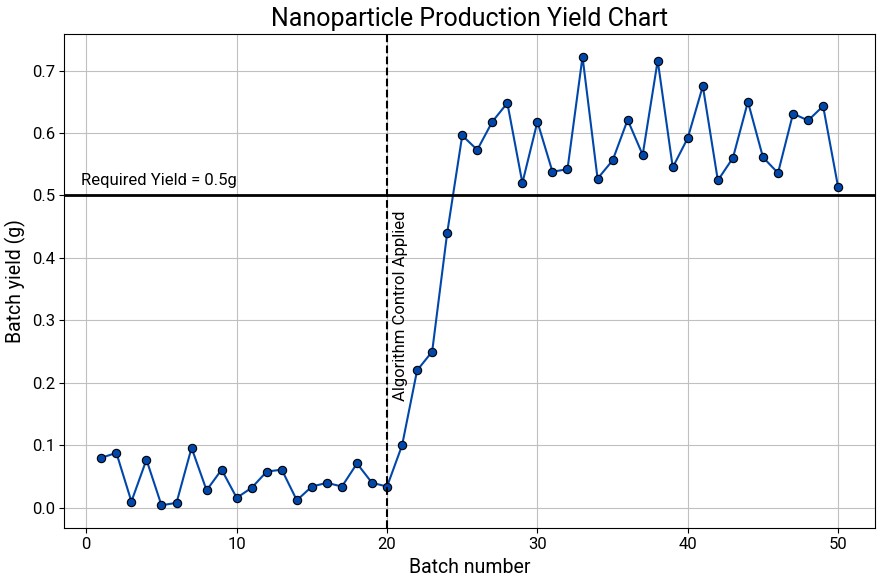
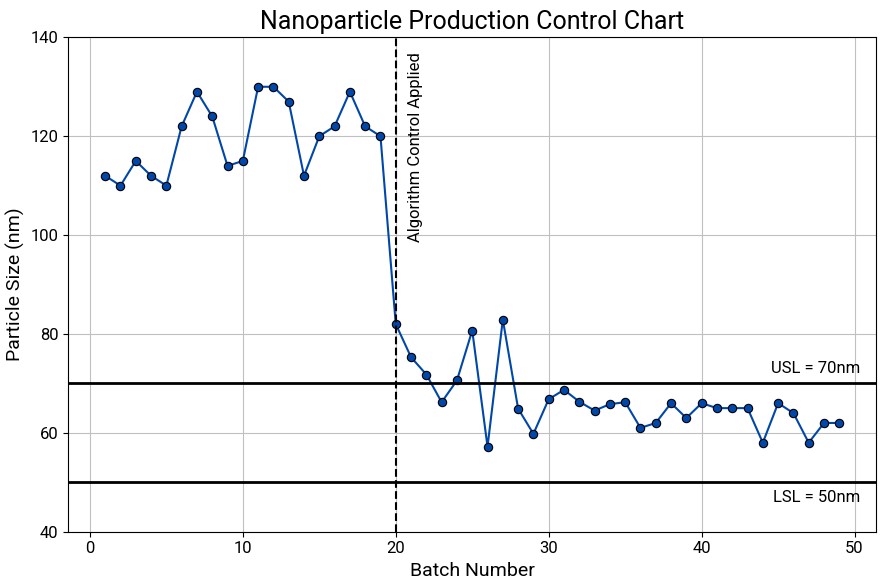
Using the process conditions recommended by the model, the client trialled a new production run. The results validated the model's predictions: batches landed within the required particle size distribution while simultaneously achieving yields at or above target — a combination that had not been reliably achieved through manual process adjustment.
Just as importantly, the client now had a data-driven map of their process parameter space, showing exactly where the "sweet spot" region sat — and how much tolerance they had around it before either specification would be put at risk. This gave the production team confidence to run closer to optimal conditions without fear of drifting out of spec.
Fig. 1 — Batch yield outcomes before and after LUCA-guided process optimisation, plotted against specification limits.
Fig. 2 — Batch outcomes before and after LUCA-guided process optimisation, plotted against specification limits.
This isn't just a nanomaterials story. Any advanced manufacturing process with multiple, interacting quality targets faces the same underlying problem.
Balancing throughput against defect rate, or feature precision against wafer yield — the same multi-objective optimisation problem, different units.
Mechanical strength vs. weight, cure time vs. structural integrity — wherever tightening one spec risks loosening another.
Where regulatory tolerances leave no room for error, and manual trial-and-error is too slow and too costly to be viable.
Find the process region where multiple specifications are satisfied together, instead of optimising one metric at the expense of another.
No new instrumentation required to start — historical batch and process data is usually enough for an initial exploratory model.
A model-guided search across your process parameter space narrows down promising conditions far faster than manual iteration.
Understand exactly how much tolerance you have around your optimal operating point — critical for regulated, spec-driven environments.
Let's find out if the same approach can work for your manufacturing process — starting with a free exploratory analysis of your data.